
At 45 years old, Alya, a woman from Tall Abbas, Akkar, has spent the past eight years working in agriculture. For her, the land is more than a place of work. It is a source of comfort, dignity, income, and pride.
“I feel at peace when I am on the land,” she says. “When the season is good, when there is production, and when we harvest what we planted, we feel happy. Our children feel happy too.”
For the past three years, she has been participating in agricultural trainings with Basmeh & Zeitooneh through the AgriForward project. Guided by the project technical trainers, she gained practical knowledge that changed the way she understands farming.
Before joining the sessions, she worked as a laborer in the fields, but she did not have enough technical information about agriculture. She did not know what type of treatment seedlings needed after planting, what could harm them, how to identify soil types, or how to better manage irrigation, fertilizers, and agricultural inputs.
“Before the trainings, I did not have this knowledge,” she explains. “I used to work in the land, but I did not know the details. Agriculture is a wide world. You may think you have learned enough and that you have become a farmer, but once you attend a session, you realize there is still so much more to learn.”
Through the trainings, she began to see agriculture differently. She learned about soil, fertilizers, pesticides, irrigation, greenhouse structures, plastic covers, support tapes, and the different materials needed to build and maintain agricultural tunnels.
She also participated in maintenance sessions, which were especially empowering. Tasks that were once seen as “men’s work” became skills that women could also learn and master.
“We started feeling that there is no difference anymore between what people call a man’s job and a woman’s job,” she says. “Before, when we saw men setting up nylon greenhouses, we used to say, ‘How difficult this must be.’ But later, we discovered that we can do it too.”
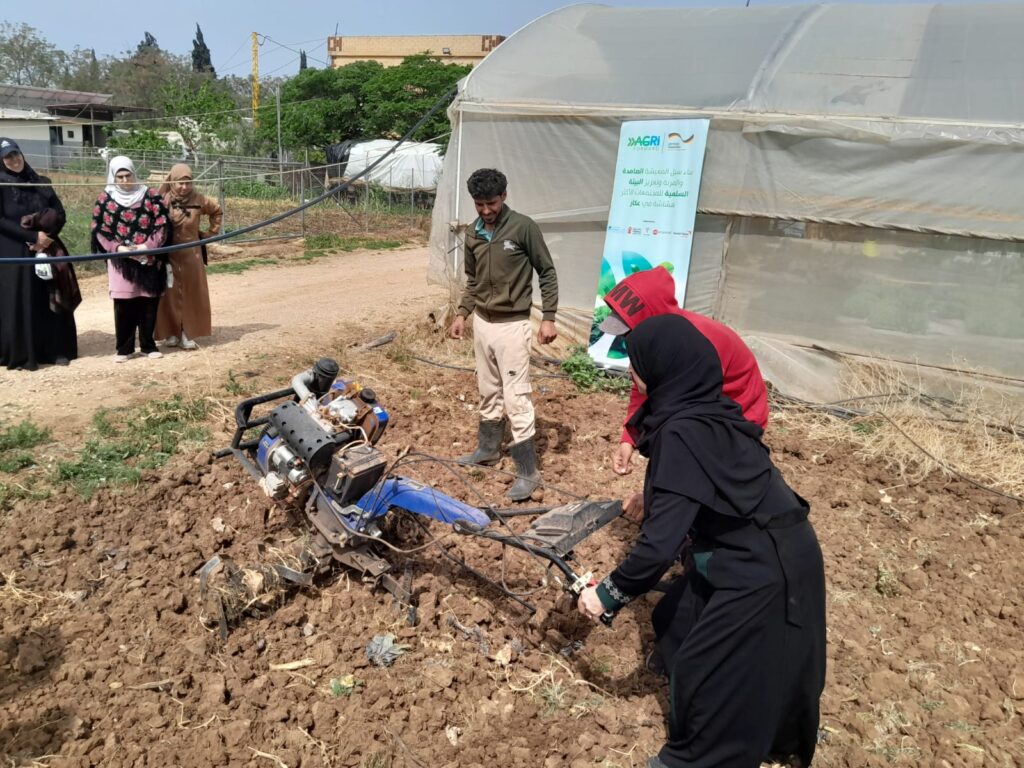
The trainings helped her gain practical independence. She learned, for example, that a land spraying machine needs oil and fuel differently from the hand-carried sprayer. She now knows how to identify what materials to buy for a greenhouse, how much nylon is needed, and what types of tapes and tools are required.
This knowledge has made her more confident and better prepared to face challenges in her work.
“We were already motivated before, and when the men were absent, we used to do the work ourselves,” she says. “But now we know how to do it better. If the sprayer stops working while I am using it, I can fix it myself.”
Her learning journey is not only changing her own life. It is also reaching her family, neighbors, and wider community. One day, a neighbor visited her, and she shared what she had learned during the sessions.
“The information is moving from one person to another,” she says. “People around us are benefiting. We learned, and now we must teach others.”
For her, the most powerful part of the project is not only the technical knowledge, but also the sense of value and recognition it has created. She wants the sessions to continue, especially those related to driving and operating agricultural machinery such as the shredder and tractor.
She believes these skills are essential for women’s independence.
“A woman’s husband may be absent. She may become widowed or divorced,” she explains. “If she has these skills, she can manage on her own. No one can cheat her or take advantage of her. She can carry the responsibility.”
Today, she feels stronger, more capable, and more confident in her role as a farmer and as a woman supporting her household and community.
“We hope the sessions continue so we can keep learning,” she says.
The AgriForward project is funded by the German Federal Ministry for Economic Cooperation and Development (BMZ) under a consortium with World Vision, Basmeh & Zeitooneh, Save the Children, Arcenciel, and Threads of Peace.
Written by: Chris Ghafary